Last updated on
Week 12: Futures and Property-based testing
Welcome to week 12 of CS-214 — Software Construction!
As usual, ⭐️ indicates the most important exercises and questions and 🔥 indicates the most challenging ones.
You do not need to complete all exercises to succeed in this class, and you do not need to do all exercises in the order they are written.
We strongly encourage you to solve the exercises on paper first, in groups. After completing a first draft on paper, you may want to check your solutions on your computer. To do so, you can pull from the course exercises repository.
Futures
Predicting future runtimes ⭐️
Let’s start our exploration of future with a series of check-yourself questions: can you predict the runtime of various combinations of futures?
We assume the following two utility functions:
def sleep(durationSec: Int): Future[Unit] =
  Future(Thread.sleep(durationSec * 1000))
futures/src/main/scala/futures/runtime/runtimePrediction.scala
def wait[T](message: String)(f: Future[T]): Unit =
  val start = System.currentTimeMillis
  Await.result(f, Duration.Inf)
  val elapsed = (System.currentTimeMillis - start) / 1000.0
  println(f"    $message: ${elapsed}%.0f seconds")
futures/src/main/scala/futures/runtime/runtimePrediction.scala
The first sleeps for durationSec sections; the second measures how long f takes to exit and then prints message along with the elapsed time.
Given these, can you predict the output of each of the lines below?
@main def predictionMain(): Unit =
  println("Single operators:")

  println("  flatMap:")

  wait("2flatMap4"):
    sleep(2).flatMap(_ => sleep(4))
  wait("4flatMap2"):
    sleep(4).flatMap(_ => sleep(2))

  println("  zip:")
  wait("2 zip 4"):
    sleep(2).zip(sleep(4))
  wait("4 zip 2"):
    sleep(4).zip(sleep(2))

  println("  sequence (;):")
  wait("2 ; 4"):
    sleep(2); sleep(4)
  wait("4 ; 2"):
    sleep(4); sleep(2)

  println("Combinations:")

  wait("2flatMap4 zip 1flatMap6"):
    sleep(2).flatMap(_ => sleep(4))
      .zip(sleep(1).flatMap(_ => sleep(6)))

  wait("2zip1 flatMap 4zip6"):
    sleep(2).zip(sleep(1)).flatMap(_ =>
      sleep(4).zip(sleep(6))
    )

  wait("2zip1 flatMap (4;6)"):
    sleep(2).zip(sleep(1)).flatMap(_ =>
      sleep(4); sleep(6)
    )

  wait("2zip1 flatMap (6;4)"):
    sleep(2).zip(sleep(1)).flatMap(_ =>
      sleep(6); sleep(4)
    )

  println("Early start:")

  wait("A=2 B=4 AflatMapB"):
    val a = sleep(2)
    val b = sleep(4)
    a.flatMap(_ => b)

  wait("A=2 B=4 AzipB"):
    val a = sleep(2)
    val b = sleep(4)
    a.zip(b)
futures/src/main/scala/main.scala
The program outputs the following:
Single operators:
  flatMap:
    2flatMap4: 6 seconds
    4flatMap2: 6 seconds
  zip:
    2 zip 4: 4 seconds
    4 zip 2: 4 seconds
  sequence (;):
    2 ; 4: 4 seconds
    4 ; 2: 2 seconds
Combinations:
    2flatMap4 zip 1flatMap6: 7 seconds
    2zip1 flatMap 4zip6: 8 seconds
    2zip1 flatMap (4;6): 8 seconds
    2zip1 flatMap (6;4): 6 seconds
Early start:
    A=2 B=4 AflatMapB: 4 seconds
    A=2 B=4 AzipB: 4 seconds
From this, we can draw the following observations:
A zip Btakes timemax(time(A), time(B))and represents a parallel composition of asynchronous operations with a join.A flatMap Btakes timetime(A) + time(B)and represents a sequential composition of asynchronous operations.A; BdiscardsAand returnsB. This meanswaitignoresAand runs only as long asB, which can even lead to the program exiting beforeAcompletes (this is not good!). Importantly, this does not runAandBsequentially: it starts them sequentially.
Making new friends ⭐️
In this exercise, we will explore different styles of writing asynchronous code in Scala: the “callback” style, the Future “monadic” style, and the Future “direct” style.
The Social Network
Consider a directed graph where nodes are users of a social network, and edges represent friendship. In our model, friendship is a symmetric relation: if a is friends with b, then b is friends with a.
Let Database be a trait that provides methods to get and update users:
trait Database:
  /** Gets a user by its id asynchronously.
    *
    * @param id
    *   Id of the user.
    * @return
    *   A `Future` that will resolve to the queried [[User]].
    */
  def getUser(id: String): Future[User]

  /** Updates a user in the database asynchronously.
    *
    * @param currentValue
    *   Current value of the user.
    * @param newValue
    *   New value of the user.
    * @return
    *   A `Future` that will resolve to `true` if the operation was successful,
    *   or `false` otherwise.
    */
  def updateUser(currentValue: User, newValue: User): Future[Boolean]

  /** Gets a user by its id asynchronously.
    *
    * @param id
    *   Id of the user.
    * @param callback
    *   Callback to call with the queried [[User]].
    */
  def getUserWithCallback(id: String)(callback: User => Unit): Unit

  /** Updates a user in the database asynchronously.
    *
    * @param currentValue
    *   Current value of the user.
    * @param newValue
    *   New value of the user.
    * @param callback
    *   Callback to call with the result of the operation. The result will be
    *   `true` if the operation was successful, or `false` otherwise.
    */
  def updateUserWithCallback(currentValue: User, newValue: User)(callback: Boolean => Unit): Unit
futures/src/main/scala/futures/friends/package.scala
Your task is to write a function makeFriends. The function should take two user identifiers user1Id: String anduser2Id: String, and a db: Database as parameters, and update the list of friends of both users to add the other user asynchronously. This means that the function should return immediately, and the friend list should be updated eventually.
In order to achieve this, you will call asynchronous functions to get and update users.
The User class is defined as follows:
case class User(id: String, friends: List[String])
futures/src/main/scala/futures/friends/package.scala
To make two users friends, you will need to:
- Get the first user from the database.
- Add the second user to the first user’s friend list.
- Update the first user in the database.
- Get the second user from the database.
- Add the first user to the second user’s friend list.
- Update the second user in the database.
- Notify the caller that the operation is complete.
To copy a User with a new list of friends, you can use its copy: method:
user.copy(friends = ???)
Sequential execution
In the first versions of makeFriends, we will perform the operations sequentially, one after the other:

In this representation, the arrows represent dependencies between operations. If there is an arrow from a to b, it means that b should only be executed after a has completed.
Callback style
The “callback” style was mostly used in the past, and is still used in some libraries. In this style, each asynchronous operation takes an additional callback function as a parameter, which is called with the desired result when the operation completes.
In this style, the makeFriendsWithCallback function takes an additional parameter callback: (Boolean, Boolean) => Unit which is called when the operation completes:
def makeFriendsWithCallback(
    user1Id: String,
    user2Id: String,
    db: Database
)(
    callback: ((Boolean, Boolean)) => Any
): Unit =
  ???
futures/src/main/scala/futures/friends/package.scala
The result of the operation is a pair of booleans, indicating whether the updates of the two users were successful.
Implement makeFriendsWithCallback by calling getUserCallback and updateUserCallback appropriately.
Testing
To test your code, copy your implementations along with the scaffold code in your favorite editor and run
makeFriendsMain with the appropriate version identifier, here callbacks:
sbt:futures> runMain makeFriendsMain callbacks
The main function runs with a mock database where each operation takes 1 second to complete. As you implemented the operations sequentially, the total time to complete the operation should be 4 seconds.
A correct implementation should print the following:
[info] running makeFriendsMain callbacks
Using callbacks
Waiting for callback to complete...
Get user aisha
Update user aisha
Get user carlos
Update user carlos
Aihsa and Carlos are now friends!
result: (true,true)
Completed in: 4 seconds
def makeFriendsWithCallback(
    user1Id: String,
    user2Id: String,
    db: Database
)(
    callback: ((Boolean, Boolean)) => Any
): Unit =
  db.getUserWithCallback(user1Id): user1 =>
    db.updateUserWithCallback(user1, user1.copy(friends = user2Id :: user1.friends)): res1 =>
      db.getUserWithCallback(user2Id): user2 =>
        db.updateUserWithCallback(user2, user2.copy(friends = user1Id :: user2.friends)): res2 =>
          callback((res1, res2))
futures/src/main/scala/futures/friends/package.scala
Monadic style, with flatMap and map
Let’s now use Futures, in the “monadic” style. In this style, each asynchronous operation returns a Future object, which represents the result of the operation. We can then use methods such as map and flatMap on the Future to transform and combine it with other Futures.
In this style, we never await on a Future directly, except at the very end of the program; your implementation must not call Await.result, Await.ready or await.
Complete the makeFriendsMonadicFlatMap function by calling the getUser and updateUser, and combining the resulting Futures using flatMap and map:
def makeFriendsMonadicFlatMap(
    user1Id: String,
    user2Id: String,
    db: Database
): Future[(Boolean, Boolean)] =
  ???
futures/src/main/scala/futures/friends/package.scala
Testing
You can test your implementation by running the runMain makeFriendsMain monadic-flatmap. A correct implementation should print the following:
Using monadic style and flatMap
Waiting for future to complete...
Get user aisha
Update user aisha
Get user carlos
Update user carlos
Aihsa and Carlos are now friends!
result: (true,true)
Completed in: 4 seconds
def makeFriendsMonadicFlatMap(
    user1Id: String,
    user2Id: String,
    db: Database
): Future[(Boolean, Boolean)] =
  db.getUser(user1Id).flatMap: user1 =>
    db.updateUser(user1, user1.copy(friends = user2Id :: user1.friends)).flatMap: res1 =>
      db.getUser(user2Id).flatMap: user2 =>
        db.updateUser(user2, user2.copy(friends = user1Id :: user2.friends)).map: res2 =>
          (res1, res2)
futures/src/main/scala/futures/friends/package.scala
Monadic style, with for-comprehensions
As you have learned, combinations of flatMap and map can be written more concisely using for-comprehensions. Rewrite the previous solution using for-comprehensions:
def makeFriendsMonadicFor(
    user1Id: String,
    user2Id: String,
    db: Database
): Future[(Boolean, Boolean)] =
  ???
futures/src/main/scala/futures/friends/package.scala
Testing
You can test your implementation by running the runMain makeFriendsMain monadic-for. It should complete in 4 seconds.
def makeFriendsMonadicFor(
    user1Id: String,
    user2Id: String,
    db: Database
): Future[(Boolean, Boolean)] =
  for
    user1 <- db.getUser(user1Id)
    res1 <- db.updateUser(user1, user1.copy(friends = user2Id :: user1.friends))
    user2 <- db.getUser(user2Id)
    res2 <- db.updateUser(user2, user2.copy(friends = user1Id :: user2.friends))
  yield (res1, res2)
futures/src/main/scala/futures/friends/package.scala
Direct style
Finally, let’s consider Futures in the “direct” style, which is a more recent style that is gaining popularity in many languages. In this style, we also use Futures, but we allow calling await from inside Futures whenever we want. This is the future of Futures in Scala, but it is not yet ready for production use for the reasons explained in the lecture.
In this style, the makeFriends function also returns a Future[(Boolean, Boolean)]:
def makeFriendsDirect(
    user1Id: String,
    user2Id: String,
    db: Database
): Future[(Boolean, Boolean)] =
  ???
futures/src/main/scala/futures/friends/package.scala
Implement it by calling the getUser and updateUser functions appropriately.
We also provide you with the following await extension method on Future that you can use to block until the result of a future is available:
extension [T](self: Future[T])
  def await: T = Await.result(self, 3.seconds)
futures/src/main/scala/futures/await.scala
In the direct style, you can call await, as long as you are inside a Future, so that you don’t block the main thread.
Testing
You can test your implementation by running the runMain makeFriendsMain direct. It should complete in 4 seconds.
def makeFriendsDirect(
    user1Id: String,
    user2Id: String,
    db: Database
): Future[(Boolean, Boolean)] =
  Future:
    val user1 = db.getUser(user1Id).await
    val res1 = db.updateUser(user1, user1.copy(friends = user2Id :: user1.friends)).await
    val user2 = db.getUser(user2Id).await
    val res2 = db.updateUser(user2, user2.copy(friends = user1Id :: user2.friends)).await
    (res1, res2)
futures/src/main/scala/futures/friends/package.scala
Parallel execution
Can we make the makeFriends function faster by executing some of the operations in parallel? Yes, we can!
Updating the two users can be done in parallel, since they are independent. Only the final operation, notifying the caller, depends on the two updates:
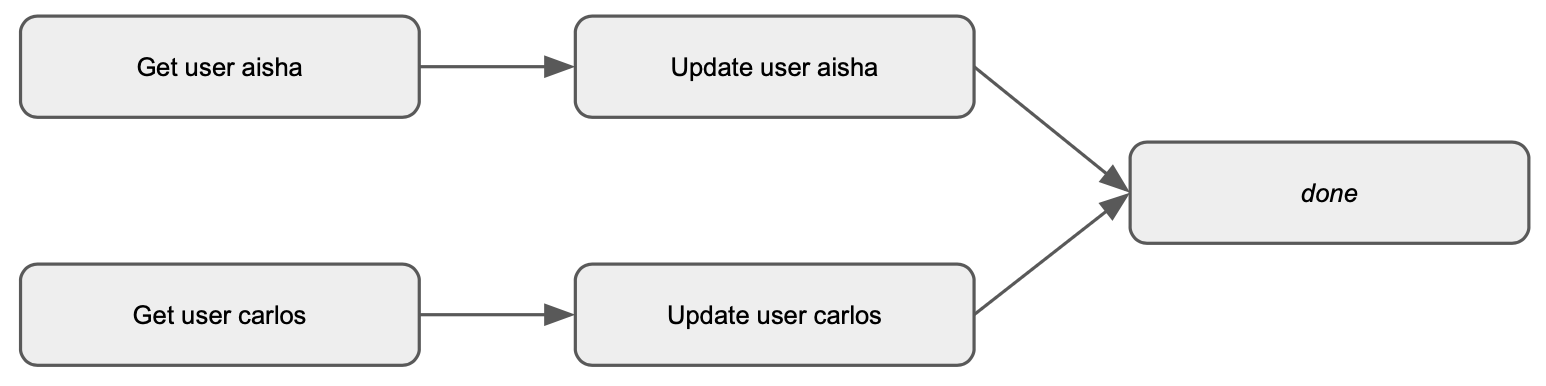
Monadic style
Implement makeFriendsMonadicParallel:
def makeFriendsMonadicParallel(
    user1Id: String,
    user2Id: String,
    db: Database
): Future[(Boolean, Boolean)] =
  ???
futures/src/main/scala/futures/friends/package.scala
Hint
You can use a combination of flatMap and map, or zip, to combine two Futures into a single Future that completes when both Futures have completed.
Testing
You can test your implementation by running the runMain makeFriendsMain monadic-flatmap-par. It should complete in 2 seconds.
def makeFriendsMonadicParallel(
    user1Id: String,
    user2Id: String,
    db: Database
): Future[(Boolean, Boolean)] =
  val res1Future =
    db.getUser(user1Id).flatMap: user1 =>
      db.updateUser(user1, user1.copy(friends = user2Id :: user1.friends))
  val res2Future =
    db.getUser(user2Id).flatMap: user2 =>
      db.updateUser(user2, user2.copy(friends = user1Id :: user2.friends))
  res1Future.zip(res2Future)
futures/src/main/scala/futures/friends/package.scala
You can also use a for-comprehension here:
def makeFriendsMonadicParallelFor(
    user1Id: String,
    user2Id: String,
    db: Database
): Future[(Boolean, Boolean)] =
  val res1Future =
    db.getUser(user1Id).flatMap: user1 =>
      db.updateUser(user1, user1.copy(friends = user2Id :: user1.friends))
  val res2Future =
    db.getUser(user2Id).flatMap: user2 =>
      db.updateUser(user2, user2.copy(friends = user1Id :: user2.friends))
  for res1 <- res1Future; res2 <- res2Future yield (res1, res2)
futures/src/main/scala/futures/friends/package.scala
Why does this work? What does the for-comprehension desugar to?
Direct style
Implement makeFriendsDirectParallel:
def makeFriendsDirectParallel(
    user1Id: String,
    user2Id: String,
    db: Database
): Future[(Boolean, Boolean)] =
  ???
futures/src/main/scala/futures/friends/package.scala
Testing
You can test your implementation by running the runMain makeFriendsMain direct-par. It should complete in 2 seconds.
def makeFriendsDirectParallel(
    user1Id: String,
    user2Id: String,
    db: Database
): Future[(Boolean, Boolean)] =
  val res1Future = Future:
    val user1 = db.getUser(user1Id).await
    db.updateUser(user1, user1.copy(friends = user2Id :: user1.friends)).await
  val res2Future = Future:
    val user2 = db.getUser(user2Id).await
    db.updateUser(user2, user2.copy(friends = user1Id :: user2.friends)).await
  Future:
    (res1Future.await, res2Future.await)
futures/src/main/scala/futures/friends/package.scala
Reimplementing parallel collections ⭐️
Remember parallel collections? How could you implement your own parallel collections using Futures?
In this exercise, you will implement ParList, a wrapper around a List that provides map, flatMap and filter methods that execute their argument functions in parallel.
def map[U](f: T => U): ParList[U] =
  ???
futures/src/main/scala/futures/parallel/ParList.scala
def flatMap[U](f: T => ParList[U]): ParList[U] =
  ???
futures/src/main/scala/futures/parallel/ParList.scala
def filter(p: T => Boolean): ParList[T] =
  ???
futures/src/main/scala/futures/parallel/ParList.scala
You can use Future.sequence to combine a list of Futures into a single Future that completes when all the Futures have completed.
def map[U](f: T => U): ParList[U] =
  val futures = data.map: t =>
    Future(f(t))
  val result = Await.result(Future.sequence(futures), Inf)
  ParList(result)
futures/src/main/scala/futures/parallel/ParList.scala
def flatMap[U](f: T => ParList[U]): ParList[U] =
  ParList(map(f).data.map(_.data).flatten)
futures/src/main/scala/futures/parallel/ParList.scala
def filter(p: T => Boolean): ParList[T] =
  flatMap: t =>
    if p(t) then ParList(List(t))
    else ParList(Nil)
futures/src/main/scala/futures/parallel/ParList.scala
Task manager
In this exercise, you will implement a simple command-line task manager. To start the REPL of the task manager, run runMain tasksMain in the sbt console.
Adding tasks
The first command to implement is add. It has the form of add <time> <text>, which runs a task that first waits for <time> seconds then prints out <text>.
Right now the tasks run synchronously.
The REPL is blocked while the task is running, and you can only enter a new command after the task has completed.
sbt:futures> runMain tasksMain
[info] compiling 1 Scala source to /Users/linyxus/Workspace/course-material/exercises/futures/target/scala-3.3.1/classes ...
> add 10 hello
Started task
Finished task: hello
>
Now your task is to make the tasks run asynchronously, by modifying the following definition:
case ADD_RE(duration, result) =>
  println(s"Started task")
  Thread.sleep(duration.toLong * 1000)
  println(s"Finished task: $result")
  loop()
futures/src/main/scala/futures/tasks/managerRepl.scala
Start by taking a look at the code in managerRepl.scala to get familiar with how the following is used throughout the program:
val tasks = collection.mutable.ArrayBuffer.empty[Future[String]]
futures/src/main/scala/futures/tasks/managerRepl.scala
Here, ADD_RE is a regex that matches the syntax of the add command.
Try numbering the tasks to distinguish them. The REPL should now work like the following:
sbt:futures> runMain tasksMain
[info] running tasksMain
> add 5 hello
> Started task #0
add 6 world
> Started task #1
Finished task #0: hello
Finished task #1: world
Tasks with dependencies
Implement another command addafter <depid> <time> <text>, which creates a task that waits for <time> seconds then prints out <text>,
but starts running only after the task with id <depid> has completed.
sbt:futures> runMain tasksMain
[info] running tasksMain
> add 5 hello
> Started task #0
addafter 0 1 world
> Finished task #0: hello
Started task #1
Finished task #1: world
In this example, we start a task (numbered 0) that prints hello after 5 seconds, then start another task (numbered 1) which runs after the first one and prints world after 1 second.
Task #1 starts only after #0 has completed.
Complete the following sketch.
case ADD_AFTER_RE(after, duration, result) =>
  ???
futures/src/main/scala/futures/tasks/managerRepl.scala
case ADD_RE(duration, result) =>
  val taskId = tasks.size
  val future =
    Future:
      println(s"Started task #$taskId")
      Thread.sleep(duration.toLong * 1000)
      println(s"Finished task #$taskId: $result")
      result
  tasks += future
  loop()
futures/src/main/scala/futures/tasks/managerRepl.scala
case ADD_AFTER_RE(after, duration, result) =>
  if after.toInt < 0 || after.toInt >= tasks.size then
    println(s"Invalid task number: $after")
    loop()
  else
    val taskId = tasks.size
    val dependency = tasks(after.toInt)
    val future = dependency.flatMap: _ =>
      Future:
        println(s"Started task #$taskId")
        Thread.sleep(duration.toLong * 1000)
        println(s"Finished task #$taskId: $result")
        result
    tasks += future
    loop()
futures/src/main/scala/futures/tasks/managerRepl.scala
Utility methods of future ⭐️
Implement the following utility methods of Future:
Hint
You may want to manipulate a Promise
rather than futures directly.
extension [T](self: Future[T])
  def map[U](f: T => U): Future[U] =
    ???
futures/src/main/scala/futures/ops/futureOps.scala
extension [T](self: Future[T])
  def flatMap[U](f: T => Future[U]): Future[U] =
    ???
futures/src/main/scala/futures/ops/futureOps.scala
extension [T](self: Future[T])
  def zip[U](other: Future[U]): Future[(T, U)] =
    ???
futures/src/main/scala/futures/ops/futureOps.scala
def sequence[T](futures: List[Future[T]]): Future[List[T]] =
  ???
futures/src/main/scala/futures/ops/futureOps.scala
def race[T](futures: List[Future[T]]): Future[T] =
  ???
futures/src/main/scala/futures/ops/futureOps.scala
You can play with your implementation by running runMain futuresTest in the sbt console.
extension [T](self: Future[T])
  def map[U](f: T => U): Future[U] =
    val promise = Promise[U]()
    self.onComplete:
      // Neat syntax trick:
      // `onComplete { case …` is the same as
      // `onComplete { x => x match case …`
      case Success(v) =>
        promise.complete(Try(f(v)))
      case Failure(e) =>
        promise.complete(Failure(e))
    promise.future
futures/src/main/scala/futures/ops/futureOps.scala
extension [T](self: Future[T])
  def flatMap[U](f: T => Future[U]): Future[U] =
    val p = Promise[U]()
    self.onComplete:
      case Success(v) =>
        Try(f(v)) match
          case Success(fvFuture) => fvFuture.onComplete(p.complete)
          case Failure(e)        => p.complete(Failure(e))
      // This branch duplicates the previous one, which is not great.
      // See below for a different solution.
      case Failure(e) => p.complete(Failure(e))
    p.future

  def flatMap2[U](f: T => Future[U]): Future[U] =
    val p = Promise[U]()
    self.onComplete: r => // More succinct version of above
      r.flatMap(v => Try(f(v))) match // This is `flatMap` on `Try`
        case Success(fvFuture) => fvFuture.onComplete(p.complete)
        case Failure(e)        => p.complete(Failure(e))
    p.future
futures/src/main/scala/futures/ops/futureOps.scala
extension [T](self: Future[T])
  def zip[U](other: Future[U]): Future[(T, U)] =
    self.flatMap: a =>
      other.map: b =>
        (a, b)
futures/src/main/scala/futures/ops/futureOps.scala
def sequence[T](futures: List[Future[T]]): Future[List[T]] =
  futures match
    case f :: fs =>
      f.flatMap: a =>
        sequence(fs).map: as =>
          a :: as
    case Nil => Future(Nil)
futures/src/main/scala/futures/ops/futureOps.scala
def race[T](futures: List[Future[T]]): Future[T] =
  val p = Promise[T]()
  futures.foreach(_.onComplete(res => if !p.isCompleted then p.complete(res)))
  p.future
futures/src/main/scala/futures/ops/futureOps.scala
GitHub contributors ⭐️
In this exercise, you will implement a function that retrieves the list of contributors of a GitHub repository, and display their names and location:
sbt:futures> runMain showContributorsMain nasa marsapi 3
[info] running (fork) showContributorsMain nasa marsapi 3
[info] Getting contributors of nasa/marsapi
[info] John from Lausanne, Switzerland
[info] Mary from somewhere
[info] James from Bangalore, India
[info] Patricia from Sydney
[info] Someone from Tokyo
The arguments to the showContributorsMain function are:
- The name of a GitHub organization.
- The name of a GitHub repository.
- The number of contributors to get per page when querying the GitHub API (see below).
GitHub API
In order to get the list of contributors of a GitHub repository, we will use the GitHub REST API, in particular the list contributors endpoint and the get user endpoint:
- The first enables us to get the list of contributors of a repository. For example, we can get the list of contributors of the
lampepfl/gearsrepository by sending a request to https://api.github.com/repos/lampepfl/gears/contributors. - The second enables us to get the details of a user. For example, we can get the details of the user
oderskyby sending a request to https://api.github.com/users/odersky.
Pagination
The GitHub API paginates the results of most endpoints that return sequences to avoid returning too much data at once.
You can control pagination using two URL parameters:
per_page: the number of results to return per page. This will be thepageSizeparameter of theshowContributorsMainandshowContributorsfunctions.page: the page number to return.
Try it with the lampepfl/gears repository!
- https://api.github.com/repos/lampepfl/gears/contributors?per_page=2
- https://api.github.com/repos/lampepfl/gears/contributors?per_page=2&page=2
- https://api.github.com/repos/lampepfl/gears/contributors?per_page=2&page=3
- https://api.github.com/repos/lampepfl/gears/contributors?per_page=2&page=4
Scala API
To call the GitHub API, we provide you with a get function that handles the JSON parsing for you. It takes a URL and returns a Future[Response[T]]:
def get[T](
    /** The URL to call. */
    uri: Uri
)(
    /** The HTTP backend used to send requests. */
    using backend: HttpBackend
)(
    /** Used to decode the response JSON to a `T`. */
    using Reader[T]
): Future[Response[T]] =
futures/src/main/scala/futures/rest/utils.scala
The Response contains the following 2 members that you will need to use:
- a
bodyfield of typeT, which contains the parsed JSON response. - a
header(String)method, which returns the value of the given HTTP header.
You can for example use it as follows to query the contributors of the nasa/marsapi repository:
// The `uri` interpolator is used to create a `Uri` from a string.
val url = uri"$API_URL/repos/nasa/marsapi/contributors?per_page=3"

// `get[T]` returns a `Future[T]`.
get[List[Contributor]](url)
  // We `map` over the `Future` to access the response.
  .map(res =>
    // res.body` is a `List[RepoContributor]`:
    assertEquals(
      res.body,
      List(
        Contributor(f"$API_URL/users/john"),
        Contributor(f"$API_URL/users/mary"),
        Contributor(f"$API_URL/users/james")
      )
    )
    // Each `Response` contains a `Link` header with a link to the next
    // page. You can use the `getNextPageUrl` function to extract the link.
    // It returns an `Option[String]`:
    assertEquals(
      getNextPageUrl(res.header("Link")),
      Some(f"$API_URL/repos/0/contributors?per_page=3&page=2")
    )
  )
futures/src/test/scala/futures/rest/GithubStubBackendTest.scala
Contributor is defined as:
case class Contributor(
    /** API URL of the corresponding user. */
    url: String
) derives ReadWriter
futures/src/main/scala/futures/rest/contributors.scala
To query the details of a user, you can use the get function as follows:
val url = uri"$API_URL/users/jennifer"
get[User](url)
  .map(res =>
    assertEquals(
      res.body,
      User(Some("Jennifer"), Some("Nairobi"))
    )
  )
futures/src/test/scala/futures/rest/GithubStubBackendTest.scala
User is defined as:
case class User(
    /** Full name of the user. */
    name: Option[String],
    /** Location of the user. */
    location: Option[String]
) derives ReadWriter:
  override def toString(): String =
    val n = name.getOrElse("Someone")
    val l = location.getOrElse("somewhere")
    f"$n from $l"
futures/src/main/scala/futures/rest/contributors.scala
Stub API
The GitHub API is rate-limited to 60 unauthenticated requests per minute.
To avoid hitting this limit and simplify testing, we provide you with a stub API that you can use instead of the real GitHub API. You can use it by providing githubStubBackend as the HttpBackend parameter to the get function.
The examples of the previous section use the stub API.
See also how we use it in the showContributorsMain implementation:
@main def showContributorsMain(
    org: String,
    repo: String,
    perPage: Int
): Unit =
  // given HttpBackend = sttp.client4.HttpClientFutureBackend
  given HttpBackend = githubStubBackend
  given Window = ConsoleWindow
  println(f"Getting contributors of $org/$repo")
  Await.result(showContributorsDirect(org, repo, perPage), 2.seconds)
futures/src/main/scala/main.scala
Our stub API only handles requests to the user and contributors endpoints, and only for two fake repositories: nasa/marsapi and sleepysloths/lazyloader which respectively have 5 and 2 stub contributors. All other requests will fail with a 404 Not Found error.
If you want to use the real GitHub API, you can set the given HttpBackend to HttpClientFutureBackend().
Order of execution
The crucial part of this exercise is the order in which the requests are executed and the results printed.
The following diagram illustrates the order in which the requests should be executed. If there is an arrow from A to B, it means that B should only be executed after A has completed.
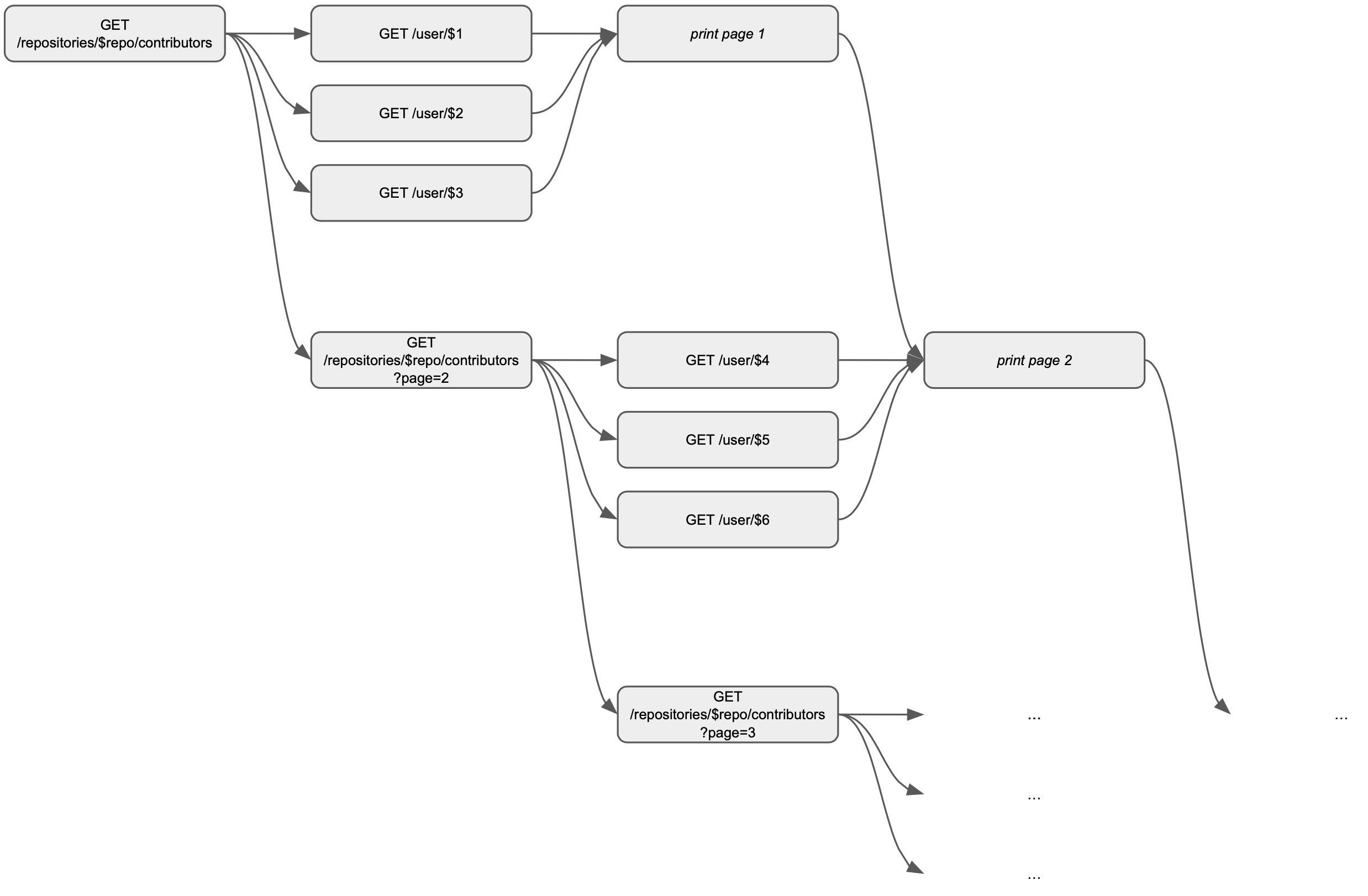
When two requests are independent, they can and must be executed in parallel. For example, the requests to get the details of users $1, $2 and $3, and the request to get the second page of contributors should all be executed in parallel.
Note also that the details of users should be printed per page, as soon as the details of all users on that page have been retrieved.
Implementation
Your task is to write a showContributors method that takes 5 parameters:
org: the name of the GitHub organization.repo: the name of the GitHub repository.pageSize: the number of contributors to get per page when querying the GitHub API.- an implicit
HttpBackendto use to query the GitHub API. - an implicit
Windowobject which contains a singleprintlnmethod, that you should use to print the results.
Write two versions:
- A version in monadic style, where you use the
zip,flatMapandmapmethods ofFuture, andFuture.sequenceto combine multiple futures. - A version in direct style: where you use the provided
awaitextension method onFutureto block until the result of a future is available.
Hint: scaffold suggestion for the monadic style version
def showContributors(
    /** The organization that owns the repository. */
    org: String,
    /** The name of the repository. */
    repo: String,
    /** The number of contributors per page. */
    perPage: Int
)(using
    /** The HTTP backend used to send requests, used by `get`. */
    HttpBackend,
    /** Used to print the results. */
    Window
): Future[Unit] =
  def showNextPage(
      pageUri: Uri,
      prevPagePrinted: Future[Unit]
  ): Future[Unit] =
    ???
  val url = uri"$API_URL/repos/$org/$repo/contributors?per_page=$perPage"
  showNextPage(url, Future.successful(()))
futures/src/main/scala/futures/rest/contributors.scala
Hint: scaffold suggestion for the direct style version
def showContributorsDirect(
    org: String,
    repo: String,
    perPage: Int
)(using HttpBackend, Window): Future[Unit] =
  def showNextPageDirect(
      pageUri: Uri,
      prevPagePrinted: Future[Unit]
  ): Future[Unit] =
    Future:
      ???

  val url = uri"$API_URL/repos/$org/$repo/contributors?per_page=$perPage"
  showNextPageDirect(url, Future.successful(()))
futures/src/main/scala/futures/rest/contributors.scala
def showContributors(
    /** The organization that owns the repository. */
    org: String,
    /** The name of the repository. */
    repo: String,
    /** The number of contributors per page. */
    perPage: Int
)(using
    /** The HTTP backend used to send requests, used by `get`. */
    HttpBackend,
    /** Used to print the results. */
    Window
): Future[Unit] =
  def showNextPage(
      pageUri: Uri,
      prevPagePrinted: Future[Unit]
  ): Future[Unit] =
    val repoContributors = get[List[Contributor]](pageUri)
    val contributors =
      repoContributors.map(_.body.map(c => get[User](uri"${c.url}")))
    val pagePrinted =
      prevPagePrinted
        .zip(contributors.flatMap(Future.sequence))
        .map(_._2.foreach(c => Window.println(c.body.toString())))
    repoContributors.flatMap(res =>
      getNextPageUrl(res.header("Link")) match
        case Some(nextPageUri) =>
          showNextPage(uri"$nextPageUri", pagePrinted)
        case None =>
          pagePrinted
    )
  val url = uri"$API_URL/repos/$org/$repo/contributors?per_page=$perPage"
  showNextPage(url, Future.successful(()))
futures/src/main/scala/futures/rest/contributors.scala
def showContributorsDirect(
    org: String,
    repo: String,
    perPage: Int
)(using HttpBackend, Window): Future[Unit] =
  def showNextPageDirect(
      pageUri: Uri,
      prevPagePrinted: Future[Unit]
  ): Future[Unit] =
    Future:
      val repoContributors = get[List[Contributor]](pageUri).await
      val contributors =
        repoContributors.body.map(c => get[User](uri"${c.url}"))
      val pagePrinted =
        Future:
          prevPagePrinted.await
          contributors
            .map(_.await)
            .foreach(c => Window.println(c.body.toString()))
      getNextPageUrl(repoContributors.header("Link")) match
        case Some(nextPageUri) =>
          showNextPageDirect(uri"$nextPageUri", pagePrinted).await
        case None =>
          pagePrinted.await

  val url = uri"$API_URL/repos/$org/$repo/contributors?per_page=$perPage"
  showNextPageDirect(url, Future.successful(()))
futures/src/main/scala/futures/rest/contributors.scala
Property-based testing
Most of the tests we have worked with so far have checked whether a program behaves correctly on a given set of example inputs, where we specify what the “correct behavior” is for each input (e.g. by checking the observed output against the hard-coded expected output). But often, we have a more abstract understanding of what it means for the program to be correct: we want the program’s output to satisfy certain properties for all inputs. In practice, the set of all possible inputs may be too large to be worth testing exhaustively (or even infinite), so we instead run the program on some randomly generated inputs. This technique is called property-based testing (PBT).
Note that PBT does not give us a 100% guarantee that the program satisfies the stated properties, because the randomly generated inputs cover only a fraction of the whole space of possible inputs. However, it still increases our confidence in the correctness of the program, and has only a moderate cost in terms of time and effort, making it a valuable component of the software correctness toolkit.
For the following exercises, we will use ScalaCheck, a Scala PBT library.
mSort
Problem 1 in the 2024 midterm gave you the implementation of an algorithm mSort and asked, “for each of the following properties, indicate whether it is true for all lists ls of type List[Int]”. Below is the implementation of mSort. The implementations of some helper functions were summarized with require-ensuring clauses in the midterm, but they are included in full below.
def mSort(ls: List[Int]): List[Int] =
  ls match
    case Nil            => Nil
    case a :: Nil       => a :: Nil
    case a :: b :: tail =>
      val (ll, lr) = split(tail)
      merge(mSort(ll), mSort(lr))

    /** Check if a given list is sorted */
def isSortedAscending(ls: List[Int]): Boolean =
  ls == ls.sortWith(_ < _)

/** Given two sorted lists, merge them into a new sorted list */
def merge(ll: List[Int], lr: List[Int]): List[Int] = {
  require(isSortedAscending(ll) && isSortedAscending(lr))

  (ll, lr) match
    case (Nil, _) => lr
    case (_, Nil) => ll
    case (lh :: lt, rh :: rt) =>
      if lh < rh then lh :: merge(lt, lr)
      else rh :: merge(ll, rt)
}.ensuring { l =>
  l == (ll ++ lr).sortWith(_ < _)
}

/** Split a list into two lists containing the first and second halves
  * respectively
  */
def split[A](ls: List[A]): (List[A], List[A]) = {
  val (ll, lr) = ls.splitAt(ls.length / 2)
  (ll, lr)

}.ensuring { case (ll, lr) =>
  ls == ll ++ lr && ll.length == ls.length / 2
}
property-based-testing/src/main/scala/pbt/MSort.scala
And here are the properties under consideration:
// Property 1
mSort(ls).length <= 1

// Property 2
mSort(ls).length <= 2

// Property 3
isSortedAscending(mSort(ls))

// Property 4
mSort(ls).length == ls.length

// Property 5
mSort(ls).length <= ls.length
-
Specify those properties in
MSortTests.scalausing ScalaCheck. If you are not sure how to use the library, consult its documentation. Change their names from “Property X” to a more descriptive but concise phrase.property("Property 1") = ??? property("Property 2") = ??? property("Property 3") = ??? property("Property 4") = ??? property("Property 5") = ???property-based-testing/src/test/scala/pbt/MSortTests.scala
-
Run the tests with
testin SBT and see if the properties hold. If a property fails, you will see a message like:failing seed for MyTest.myproperty is 8BrWGTql0mzLgIvMVGiNy0ElC7pOMWhVE3xcntwGbOF= [info] ! MyTest.myproperty: Falsified after 8 passed tests. [info] > ARG_0: List("0", "0") [info] > ARG_0_ORIGINAL: List("-1375979208", "2147483647")- The “seed”,
8BrW…, is for the pseudorandom input generator. It is printed so that you can reproduce the failure with the “same” random inputs if needed:testOnly -- -initialSeed 8BrW…. ARG_0refers to the first (zero-indexed) argument to the property.ARG_0_ORIGINALis the original input that triggered the failure; ScalaCheck tries to automatically simplify and minimize such inputs for easier debugging, andARG_0is the minimal input it could find.
- The “seed”,
-
If a property doesn’t hold, decide whether it should hold for a correct implementation or the property itself is incorrect. Fix the implementation of
mSortso that the right properties hold.
-
Here are the implementations of the properties:
property("length no more than 1") =
  // This property does not hold of the provided implementation. Should it?
  forAll((l: List[Int]) => true)
  // forAll((l: List[Int]) => mSort(l).length <= 1)

property("length no more than 2") =
  // This property does not hold of the provided implementation. Should it?
  forAll((l: List[Int]) => true)
  // forAll((l: List[Int]) => mSort(l).length <= 2)

property("is sorted after mSort") =
  forAll((l: List[Int]) => isSortedAscending(mSort(l)))

property("length preserved") =
  // This property does not hold of the provided implementation. Should it?
  forAll((l: List[Int]) => true)
  // forAll((l: List[Int]) => mSort(l).length == l.length)

property("length no more than before") =
  forAll((l: List[Int]) => mSort(l).length <= l.length)
property-based-testing/src/test/scala/pbt/MSortTests.scala
-
Only the properties 3 and 5 should hold.
-
Here is the correct implementation of
mSort:def mSort(ls: List[Int]): List[Int] = ls match case Nil => Nil case a :: Nil => a :: Nil case a :: b :: tail => // Here: `split` was called on `tail` instead of `ls` val (ll, lr) = split(ls) merge(mSort(ll), mSort(lr)) /** Check if a given list is sorted */ def isSortedAscending(ls: List[Int]): Boolean = ls == ls.sortWith(_ < _) /** Given two sorted lists, merge them into a new sorted list */ def merge(ll: List[Int], lr: List[Int]): List[Int] = { require(isSortedAscending(ll) && isSortedAscending(lr)) (ll, lr) match case (Nil, _) => lr case (_, Nil) => ll case (lh :: lt, rh :: rt) => if lh < rh then lh :: merge(lt, lr) else rh :: merge(ll, rt) }.ensuring { l => l == (ll ++ lr).sortWith(_ < _) } /** Split a list into two lists containing the first and second halves * respectively */ def split[A](ls: List[A]): (List[A], List[A]) = { val (ll, lr) = ls.splitAt(ls.length / 2) (ll, lr) }.ensuring { case (ll, lr) => ls == ll ++ lr && ll.length == ls.length / 2 }property-based-testing/src/main/scala/pbt/MSort.scala
Quadtrees ⭐️
A few weeks ago, we tried to improve boids with a new data structure:
In an attempt at making a
boidscallback better, we have implemented a quadtree data structure to hold boid collections. Quadtrees are a two-dimensional analogue of binary search trees: they are used to organize point clouds in a way that supports quick filtering and lookups (inboids, this would allow us to quickly determine which boids are close to each other, in much less time than a linear filter of all boids).
We implemented a number of methods on the quadtree: size, insert, contains, filter, iterator and a fromCollection. Sadly, under release deadline pressure, our implementation was buggy. Your task in this exercise is to identify the bugs using property-based tests, find and fix them in the code, and finally (to finish the task we started) patch boids to use the quadtree.
Here is the type definition of a quadtree:
enum QuadTree[+T] extends Iterable[T]:
  case Empty
  case Leaf(t: List[WithPos[T]])
  case Quad(center: Vector2, nw: QuadTree[T], ne: QuadTree[T], sw: QuadTree[T], se: QuadTree[T])
property-based-testing/src/main/scala/pbt/QuadTree.scala
Which properties?
First, write down, on paper, the properties that you think a quadtree with the methods mentioned above should satisfy. For example, what can you say about the size of a quadtree? How does the size change after inserting an element, or after filtering the quadtree with various predicates?
Here are some properties that you might want to check:
- The size of a tree should always be greater than or equal to 0.
- The size of a tree should increase by 1 after inserting an element.
- A tree should contain an element after inserting it.
- A tree should contain an element after inserting it and then inserting arbitrarily many other elements.
- The size of a tree should be the same after filtering by a predicate that is always true.
- The size of a tree should be 0 after filtering by a predicate that is always false.
- The size of a tree should be less than or equal to the size of the original tree after filtering by an arbitrary predicate.
- A tree should contain an element after inserting it and then filtering by a predicate that holds for the element.
- A tree should not contain an element after inserting it and then filtering by a predicate that does not hold for the element.
- A tree created from another collection should contain all the elements of the collection.
- A tree created from another collection should have the same size as the collection.
There are multiple possible ways to test the interaction between the iterator method and the others, and to test the equivalence of trees created with the same elements in different ways. There are many other reasonable meaningful properties you could check about quadtrees.
PBT with custom types
PBT works by generating random inputs of the right types for the properties being tested. ScalaCheck has predefined generators for standard types like Int and List, but not for the custom types we’ve defined, like Vector2 and QuadTree, so you will have to write those generators. Here is an example for Vector2:
case class PosBounds(xMin: Double, xMax: Double, yMin: Double, yMax: Double):
  val xRange = xMax - xMin
  val yRange = yMax - yMin
  def transformX(x: Double): Double = x * xRange + xMin
  def transformY(y: Double): Double = y * yRange + yMin
given PosBounds(-100, 100, -100, 100)

def position(using bounds: PosBounds): Gen[Vector2] =
  for
    x <- Gen.double
    y <- Gen.double
  yield Vector2(bounds.transformX(x), bounds.transformY(y))
property-based-testing/src/test/scala/pbt/QuadTreeTests.scala
Gen.double uniformly samples the interval [0, 1), which we linearly transform to the interval specified in bounds. There is a default given instance of PosBounds, but code that calls position may pass in more specific instances.
Note that the generator does not explicitly use any randomness or specify the order in which random inputs are generated—it just generates one random input, delegating the randomness to Gen.double. In general, all the generators you write will be composed of these constructors (such as Gen.const) and combinators (such as Gen.listOfN) provided by ScalaCheck. Read the ScalaCheck user guide to learn how to use them. If you need even more details, consult the API documentation.
-
Implement the generator for the
WithPosclass.def withPos(using bounds: PosBounds): Gen[WithPos[Double]] = ???property-based-testing/src/test/scala/pbt/QuadTreeTests.scala
-
Implement the generator for an
Emptyquadtree.val genEmpty: Gen[QuadTree[Double]] = ???property-based-testing/src/test/scala/pbt/QuadTreeTests.scala
-
Implement the generator for a
Leafquadtree. Respect the invariant that a leaf can only have up to 4 elements.def genLeaves(using bounds: PosBounds): Gen[QuadTree[Double]] = ???property-based-testing/src/test/scala/pbt/QuadTreeTests.scala
-
Implement the generator for a
Quadquadtree. Use theboundsparameter to respect the invariant that all elements in thenwquadtree should be to the northwest of thepivotof theQuad, etc.def genQuads(using bounds: PosBounds): Gen[QuadTree[Double]] = ???property-based-testing/src/test/scala/pbt/QuadTreeTests.scala
-
Implement the generator for a
QuadTree. Hint: “Generating case classes” in the ScalaCheck user guide.val genQuadTree: Gen[QuadTree[Double]] = ???property-based-testing/src/test/scala/pbt/QuadTreeTests.scala
Here are the implementations of the generators:
case class PosBounds(xMin: Double, xMax: Double, yMin: Double, yMax: Double):
  val xRange = xMax - xMin
  val yRange = yMax - yMin
  def transformX(x: Double): Double = x * xRange + xMin
  def transformY(y: Double): Double = y * yRange + yMin
given PosBounds(-100, 100, -100, 100)

def position(using bounds: PosBounds): Gen[Vector2] =
  // we don't use Gen.chooseNum because it prioritizes "special values" like 0, MAX, etc. and this produces duplicate positions, which we don't support
  for
    x <- Gen.double
    y <- Gen.double
  yield Vector2(bounds.transformX(x), bounds.transformY(y))
property-based-testing/src/test/scala/pbt/QuadTreeTests.scala
def withPos(using bounds: PosBounds): Gen[WithPos[Double]] =
  for
    pos <- position
    value <- Gen.double
  yield WithPos(pos, value)
property-based-testing/src/test/scala/pbt/QuadTreeTests.scala
val genEmpty: Gen[QuadTree[Double]] =
  const(QuadTree.Empty)
property-based-testing/src/test/scala/pbt/QuadTreeTests.scala
def genLeaves(using bounds: PosBounds): Gen[QuadTree[Double]] =
  for
    n <- Gen.choose[Int](1, QuadTree.MAX_LEAF_SIZE)
    ts <- listOfN(n, withPos)
  yield QuadTree.Leaf(ts)
property-based-testing/src/test/scala/pbt/QuadTreeTests.scala
def genQuads(using bounds: PosBounds): Gen[QuadTree[Double]] =
  sized: maxDepth =>
    if maxDepth <= 0 then genLeaves
    else
      for
        center <- position
        nw <- Gen.resize(maxDepth / 4, genQuads(using bounds.copy(xMax = center.x, yMax = center.y)))
        ne <- Gen.resize(maxDepth / 4, genQuads(using bounds.copy(xMin = center.x, yMax = center.y)))
        sw <- Gen.resize(maxDepth / 4, genQuads(using bounds.copy(xMax = center.x, yMin = center.y)))
        se <- Gen.resize(maxDepth / 4, genQuads(using bounds.copy(xMin = center.x, yMin = center.y)))
      yield QuadTree.Quad(center, nw, ne, sw, se)
property-based-testing/src/test/scala/pbt/QuadTreeTests.scala
val genQuadTree: Gen[QuadTree[Double]] =
  oneOf(genEmpty, genLeaves, genQuads)
property-based-testing/src/test/scala/pbt/QuadTreeTests.scala
Implementing properties
Now that we have generators for our custom types, implement the properties you previously identified.
🔜 Technically, there is one more step before ScalaCheck can use our custom generators, involving given instances of the Arbitrary class. We’ve already written that code for you, so you can ignore it for now, but you can read the relevant sections of the user guide if you are curious. We will come back to this in a later exercise.
Here are the properties:
def insertAll[T](t0: QuadTree[T])(ws: Iterable[WithPos[T]]) =
  ws.foldLeft(t0)(_.insert(_))

property("sizePossibleValues") =
  forAll: (t: QuadTree[Double]) =>
    t.size >= 0

property("insertSize") =
  forAll: (t: QuadTree[Double], w: WithPos[Double]) =>
    t.insert(w).size == t.size + 1

property("insertContains") =
  forAll: (t: QuadTree[Double], w: WithPos[Double]) =>
    t.insert(w).contains(w)

property("insertMultipleContains") =
  forAll: (t: QuadTree[Double], w: WithPos[Double], ws: List[WithPos[Double]]) =>
    insertAll(t.insert(w))(ws).contains(w)

property("filterAllTrueSize") =
  forAll: (t: QuadTree[Double]) =>
    t.filter(
      xmin = Double.MinValue,
      xmax = Double.MaxValue,
      ymin = Double.MinValue,
      ymax = Double.MaxValue,
      pred = _ => true
    ).size == t.size

property("filterAllFalseSize") =
  forAll: (t: QuadTree[Double]) =>
    t.filter(
      xmin = Double.MaxValue,
      xmax = Double.MinValue,
      ymin = Double.MaxValue,
      ymax = Double.MinValue,
      pred = _ => false
    ).size == 0

property("filterArbitrarySize") =
  forAll: (t: QuadTree[Double], f: Double => Boolean) =>
    t.filter(
      xmin = Double.MinValue,
      xmax = Double.MaxValue,
      ymin = Double.MinValue,
      ymax = Double.MaxValue,
      pred = f
    ).size <= t.size

property("filterWOnInsert") =
  forAll: (t: QuadTree[Double], w: WithPos[Double], f: Double => Boolean) =>
    t.insert(w).filter(
      xmin = w.pos.x,
      xmax = w.pos.x,
      ymin = w.pos.y,
      ymax = w.pos.y,
      pred = elem => if elem == w.t then true else f(elem)
    ).contains(w)

property("filterNotWOnInsert") =
  forAll: (t: QuadTree[Double], w: WithPos[Double], f: Double => Boolean) =>
    !t.insert(w).filter(
      xmin = w.pos.x,
      xmax = w.pos.x,
      ymin = w.pos.y,
      ymax = w.pos.y,
      pred = elem => if elem == w.t then false else f(elem)
    ).contains(w)

property("fromCollectionSize") =
  forAll: (ts: List[Double], pos: Double => Vector2) =>
    QuadTree.fromCollection(ts, pos).size == ts.size

property("fromCollectionContainsAll") =
  forAll: (ts: List[Double], pos: Double => Vector2) =>
    val tree = QuadTree.fromCollection(ts, pos)
    ts.forall(t => tree.contains(WithPos(pos(t), t)))

property("fromSetIteratorSet") =
  forAll: (ts: Set[Double], pos: Double => Vector2) =>
    val tree = QuadTree.fromCollection(ts, pos)
    ts == tree.iterator.toSet

property("emptyInsertMultipleIterator") =
  forAll: (ts: Set[Double], pos: Double => Vector2) =>
    ts.foldLeft[QuadTree[Double]](QuadTree.Empty)((t, w) => t.insert(WithPos(pos(w), w))).iterator.toSet == ts

property("treeInsertMultipleIterator") =
  forAll: (tree: QuadTree[Double], ts: Set[Double], pos: Double => Vector2) =>
    insertAll(tree)(ts.map(w => WithPos(pos(w), w))).iterator.toSet == (tree.iterator.toSet | ts)

property("Filtering respects the given boundary") =
  forAll: (ws: List[WithPos[Double]], xmax: Double, xmin: Double, ymax: Double, ymin: Double) =>
    val tree = insertAll(QuadTree.Empty)(ws)
    val filtered = tree.filter(xmin, xmax, ymin, ymax, x => true)
    def inBounds(v: WithPos[Double]): Boolean =
      v.pos.x >= xmin && v.pos.x <= xmax &&
        v.pos.y >= ymin && v.pos.y <= ymax
    ws.forall(x => inBounds(x) == filtered.contains(x))
property-based-testing/src/test/scala/pbt/QuadTreeTests.scala
Fixing the bugs
Run the tests and see if the properties you wrote hold. If they don’t, either fix the implementation of the quadtree so that they do, or fix the properties to better reflect how a “correct” quadtree should behave.
🔥 There is one bug that is nearly unreachable with PBT, that causes an infinite recursion. Post on Ed if you are able to find it with PBT or with some other technique! And come to the verification lecture to find out how to do even better than PBT and eliminate such bugs entirely.
Here is the correct implementation of the quadtree:
  override def size: Int =
    this match
      case Empty =>
        0
      case Leaf(ts) =>
        ts.length
      case Quad(center, nw, ne, sw, se) =>
        nw.size + ne.size + sw.size + se.size

  def insert[U >: T](t: WithPos[U]): QuadTree[U] =
    this match
      case Empty    => Leaf(List(t))
      case Leaf(ts) =>
        // 🔥 Why should we have this require clause?
        // No solution provided; ask on Ed if you want to check your answer.
        require(!ts.exists(_.pos == t.pos))
        if this.size >= QuadTree.MAX_LEAF_SIZE then
          // See write-up for explanation of infinite loop bug
          val items = scala.util.Random.shuffle(ts)
          val pivot = items.head.pos
          val q: QuadTree[U] = Quad(pivot, Empty, Empty, Empty, Empty)
          items.foldLeft(q)(_.insert(_)).insert(t)
        else
          // This is needlessly inefficient. It should be replaced by
          // Leaf(t :: ts1)
          // But PBT won't help detect this, as it is a performance issue,
          // not a correctness issue.
          Leaf(ts ++ List(t))
      case Quad(center, nw, ne, sw, se) =>
        val pos = t.pos
        if pos.y <= center.y then
          if pos.x <= center.x then
            Quad(center, nw.insert(t), ne, sw, se)
          else
            Quad(center, nw, ne.insert(t), sw, se)
        else if pos.x <= center.x then
          Quad(center, nw, ne, sw.insert(t), se)
        else
          Quad(center, nw, ne, sw, se.insert(t))

  def contains[U >: T](w: WithPos[U]): Boolean =
    this match
      case Empty => false
      case Leaf(ts) =>
        ts.contains(w)
      case Quad(center, nw, ne, sw, se) =>
        val pos = w.pos
        if pos.y <= center.y then
          if pos.x <= center.x then
            nw.contains(w)
          else
            ne.contains(w)
        else if pos.x <= center.x then
          sw.contains(w)
        else
          se.contains(w)

  def filter(xmin: Double, xmax: Double, ymin: Double, ymax: Double, pred: T => Boolean): QuadTree[T] =
    this match
      case Empty => Empty
      case Leaf(ts) =>
        Leaf(ts.filter(wp => wp.pos.inBounds(xmin, xmax, ymin, ymax) && pred(wp.t)))
      case Quad(center, nw, ne, sw, se) =>
        Quad(
          center,
          if xmin > center.x || ymin > center.y then Empty
          else nw.filter(xmin, xmax, ymin, ymax, pred),
          if xmax <= center.x || ymin > center.y then Empty
          else ne.filter(xmin, xmax, ymin, ymax, pred),
          if xmin > center.x || ymax <= center.y then Empty
          else sw.filter(xmin, xmax, ymin, ymax, pred),
          if xmax <= center.x || ymax <= center.y then Empty
          else se.filter(xmin, xmax, ymin, ymax, pred)
        )

  def iterator: Iterator[T] =
    this match
      case Empty    => Iterator.empty
      case Leaf(ts) => ts.iterator.map(_.t)
      case Quad(center, nw, ne, sw, se) =>
        nw.iterator
          .concat(ne.iterator)
          .concat(sw.iterator)
          .concat(se.iterator)

object QuadTree:
  def fromCollection[T](ts: Iterable[T], pos: T => Vector2) =
    ts.foldLeft(Empty: QuadTree[T])((qt, t) =>
      qt.insert(WithPos(pos(t), t))
    )

  val MAX_LEAF_SIZE = 4
property-based-testing/src/main/scala/pbt/QuadTree.scala
🔥 A Leaf stores up to 4 elements. When a 5th is inserted, it splits into a Quad and redistributes the elements according to their positions. The centroid of the original 4 elements is used as the pivot of the new quad. Mathematically, the centroid is equal to the position of one of the elements only if all the elements are at the same position, and as we require elements to be in distinct positions, this should never happen; however, our positions are implemented with doubles, and floating-point arithmetic does not have the mentioned property. The test below gives a counterexample (there are many). Now, if the centroid is such that all 5 elements fall into the same quadrant (i.e. northwest in our case, due to the <= comparisons), that leaf will again have 5 elements, starting the same redistribution process all over again. The elements will be inserted (with foldLeft) and stored (with ++) in the same order, and the computed centroid will be the same.
// see https://float.exposed/0x46293e5939a08cea
val a = 1.0e30
val b = 1.0000000000000002e30
val c = 1.0000000000000003e30

val q = QuadTree.Leaf(List(
  WithPos(Vector2(a, c), 1.0),
  WithPos(Vector2(b, c), 2.0),
  WithPos(Vector2(b, b), 3.0),
  WithPos(Vector2(b, a), 4.0)
))
// ensure a split on the next insert
assertEquals(q.size, QuadTree.MAX_LEAF_SIZE)

// centroid coincides with southeastern-most point
val centroidX = (a + b + b + b) / 4
val centroidY = (c + c + b + a) / 4
assertEquals(Vector2(centroidX, centroidY), Vector2(b, c))

// infinite recursion bug on this insert
val qq = q.insert(WithPos(Vector2(0.9e29, 0.9e29), 5.0))
assertEquals(qq.size, q.size + 1)
property-based-testing/src/test/scala/pbt/QuadTreeStackOverflow.scala
This bug is hard to detect using PBT because it requires 4 elements to be generated with specific positions and in such an order that their centroid violates the stated mathematical property due to floating-point arithmetic nuances. It is unlikely that these conditions will be produced by random input generation.
Funnily enough, our fix for this bug uses randomization: we shuffle the elements before picking the first one as the center. The probability that we still pick the bottom-right-most element, and hence trigger the redistribution again, is then 1/5. So the probability that it recurses twice is 1/25, and that it recurses three times is 1/125, and so on; the probability of an infinite recursion is zero. The general insight here is that randomization is a useful technique to fix imbalanced data structures in the average case.